Albert Einstein
Albert Einstein was a theoretical physicist whose work reshaped modern understandings of space, time, gravity, and light. He remains one of the most recognizable scientific thinkers of the twentieth century.
- Sun
- Pisces
- Moon
- Sagittarius
- Rising
- Cancer
Birth details
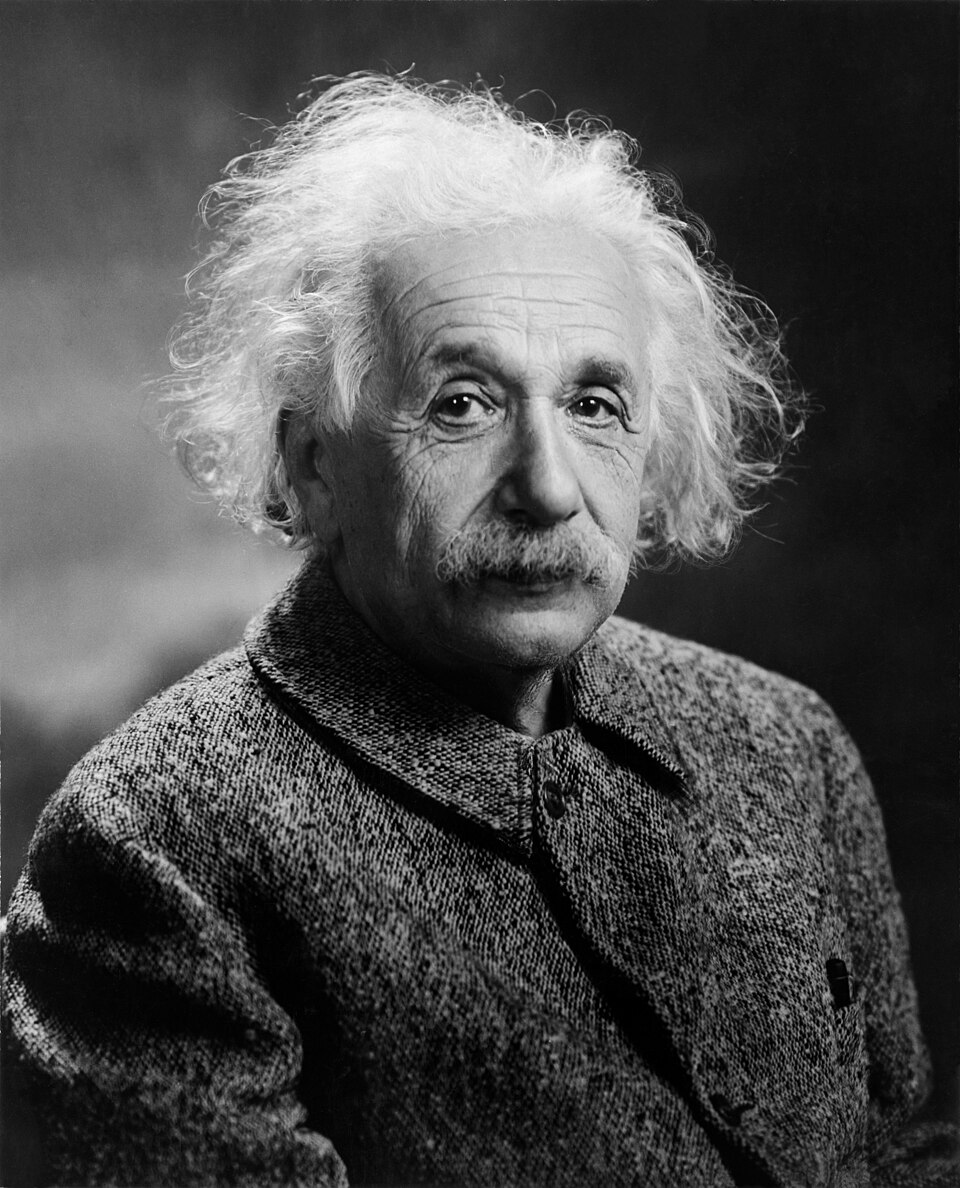
Image credit
Oren Jack Turner · This image is available from the United States Library of Congress's Prints and Photographs division under the digital ID cph.3b46036.This tag does not indicate the copyright status of the attached work. A normal copyright tag is still required. See Commons:Licensing.
Public domainWikimedia Commons
- Born
- March 14, 1879
- Time
- 11:30
- Place
- Ulm, Germany
- Timezone
- UTC +0:53
Why this chart stands out
Pisces Sun in the 10th house, Sagittarius Moon in the 6th, and Cancer rising. The close Mercury–Saturn conjunction, supported by a Sun–Pluto sextile, creates a distinctive structure for examining disciplined thought alongside depth and persistence.
Planets
- Sun in PiscesHouse 10
- 23° 30′
- Moon in SagittariusHouse 6
- 14° 24′
- Mercury in AriesHouse 10
- 3° 08′
- Venus in AriesHouse 11
- 16° 58′
- Mars in CapricornHouse 8
- 26° 54′
- Jupiter in AquariusHouse 9
- 27° 29′
- Saturn in AriesHouse 10
- 4° 11′
- Uranus in VirgoHouse 3
- 1° 17′
- Neptune in TaurusHouse 11
- 7° 52′
- Pluto in TaurusHouse 11
- 24° 44′
Beyond the planets
- ASCAscendant in CancerHouse 1
- 8° 50′
- DSCDescendant in CapricornHouse 7
- 8° 50′
- MCMidheaven in PiscesHouse 10
- 9° 13′
- ICImum Coeli in VirgoHouse 4
- 9° 13′
- True North Node in AquariusHouse 8
- 2° 44′
- Chiron in TaurusHouse 11
- 5° 33′
Your chart next
The sky at your birth.
Create your free birth chart. Explore its planets and patterns at your own pace, and discover the story in your sky.
Aspects · by closeness
- Mercury Sextile True North NodeOrb: 0° 24′
- Mercury Conjunction SaturnOrb: 1° 04′
- Sun Sextile PlutoOrb: 1° 14′
- Mars Trine PlutoOrb: 2° 11′
- Moon Trine VenusOrb: 2° 35′
- Jupiter Square PlutoOrb: 2° 45′
- Saturn Sextile True North NodeOrb: 1° 27′
Houses · Placidus
What's this?
Houses divide the chart into twelve areas of life. A planet’s house describes where its symbolism is most likely to be expressed. Houses I, IV, VII and X are known as angular houses and relate to identity, home, partnership and public direction. Their exact relationship to the Ascendant, Midheaven and other angles depends on the selected house system.
Objects in house 1:
- ASCAscendant8° 50′ Cancer
No displayed planets or points occupy house 2. An empty house is not unimportant; its Cancer cusp remains a starting point for interpretation.
Objects in house 3:
- Uranus1° 17′ Virgo
Objects in house 4:
- ICImum Coeli9° 13′ Virgo
No displayed planets or points occupy house 5. An empty house is not unimportant; its Libra cusp remains a starting point for interpretation.
Objects in house 6:
- Moon14° 24′ Sagittarius
Objects in house 7:
- DSCDescendant8° 50′ Capricorn
Objects in house 8:
- Mars26° 54′ Capricorn
- True North Node2° 44′ Aquarius
Objects in house 9:
- Jupiter27° 29′ Aquarius
Objects in house 10:
- Sun23° 30′ Pisces
- Mercury3° 08′ Aries
- Saturn4° 11′ Aries
- MCMidheaven9° 13′ Pisces
Objects in house 11:
- Venus16° 58′ Aries
- Neptune7° 52′ Taurus
- Pluto24° 44′ Taurus
- Chiron5° 33′ Taurus
No displayed planets or points occupy house 12. An empty house is not unimportant; its Taurus cusp remains a starting point for interpretation.
Chart patterns
Geometric configurations formed by aspects between planets and points.
No qualifying patterns were detected with the current settings.
CHART SIGNATURE
What's this?Close
Chart Signature looks at the chart as a whole instead of reading every placement in isolation. The element and modality balance gives equal weight to the Sun, Moon, Mercury, Venus, Mars, Jupiter, Saturn, Uranus, Neptune and Pluto, plus the Ascendant when the birth time is reliable. The Midheaven is excluded from this balance. The observations draw on planetary distribution, accepted aspects, retrogrades, sign concentrations and dispositor relationships. Only clear structural patterns are shown.
Astrological systems can use different objects and thresholds. This section follows AstrowlAI's approach and is not a universal standard.
BY ELEMENT
- Fire
- 4
- Earth
- 4
- Air
- 1
- Water
- 2
BY MODALITY
- Cardinal
- 5
- Fixed
- 3
- Mutable
- 3
Structural observations
Bucket chart shape
Uranus stands apart as the handle while the other nine planets form one body.
Neptune has no accepted aspects
Under the current aspect settings, Neptune forms no accepted aspects.
Eastern hemisphere emphasis
7 of the ten planets fall on the Ascendant side of the chart.
Above-horizon emphasis
8 of the ten planets are above the horizon.
Aries concentration
Mercury, Venus, and Saturn gather in Aries (3 objects).
Show moreShow less
Fourth quadrant concentration
6 of the ten planets occupy the Fourth quadrant.
A single Air carrier
Jupiter is the only signature-core object carrying Air.
Mutual reception
Mars and Saturn occupy signs ruled by one another under the V1 modern rulership table.
Advanced statisticsClose advanced statistics
Objects11
Elements
Balance index0.91
A distribution measure from 0 to 1; it is not a rating.
- Fire
- 4 · 36%
- Earth
- 4 · 36%
- Air
- 1 · 9%
- Water
- 2 · 18%
- Joint leaders
- Fire · Earth
- Missing
- —
Modalities
Balance index0.97
A distribution measure from 0 to 1; it is not a rating.
- Cardinal
- 5 · 45%
- Fixed
- 3 · 27%
- Mutable
- 3 · 27%
- Joint leaders
- Cardinal
- Missing
- —
| Element × modality | Cardinal | Fixed | Mutable |
|---|---|---|---|
| Fire | 3 | 0 | 1 |
| Earth | 1 | 2 | 1 |
| Air | 0 | 1 | 0 |
| Water | 1 | 0 | 1 |
 Steve Jobs